April 2nd will mark the first anniversary of the Trump administration’s Liberation Day tariff announcement, and things haven’t gone the way anyone thought.
The forecasts of an immediate recession proved wrong. The promises of rapid reindustrialisation and mass employment in manufacturing have also turned out to be incorrect.
If there were to be a rush of reshoring and investment in manufacturing in the US, one would expect manufacturing construction spending to increase, but it has done the opposite in the last year. In fact, it has been on a constant downward run since… January 2025. What happened then?
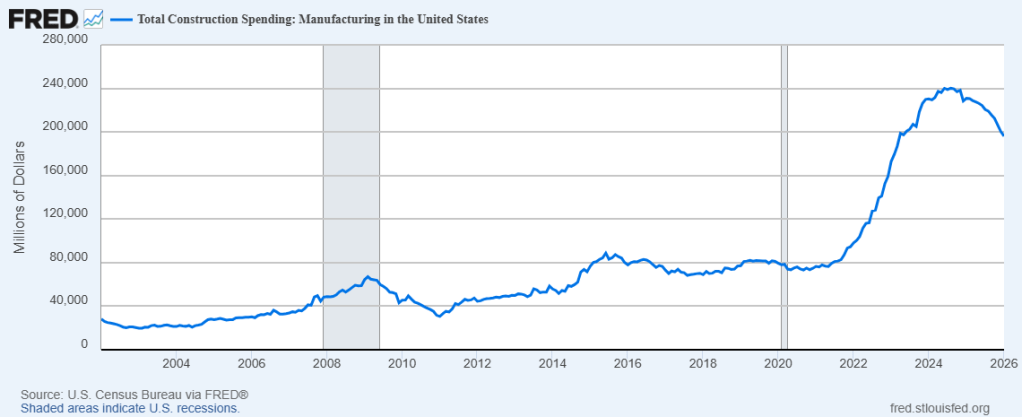
Granted, construction spending is a lagging indicator, so more may come online in the next 12 months. But data on employment tells a similar story of decline. Though it’s not a sharp as the construction downturn.
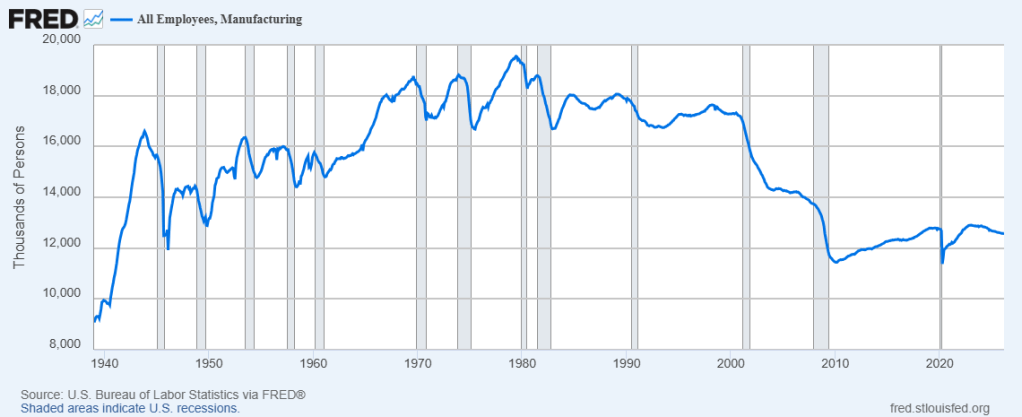
Even with the promise of new semiconductor fabs in Arizona and locking China out of more supply chains, American workers and investors are proving resilient to President Trump’s tariff nudges. Perhaps they saw the Supreme Court’s ruling that country-specific tariffs are illegal coming. Or perhaps there were simply better jobs and opportunities elswhere, even allowing for the tariff deterrent.
Once place we might be able to see a tariff consequence in the prices consumers pay for electronics and other imported goods. Their ‘tariff incidence’ makes for a tough read.
According to the New York Fed, “nearly 90 percent of the tariffs’ economic burden fell on U.S. firms and consumers.”
They outline how the incidence of tariffs throughout 2025 was borne mostly by US importers. They put the number between 86% and 94%. But of course, those importers are running charities; they pass on costs to consumers.
So, in a shock to absolutely nobody. Trump’s tariffs have had at best a neutral effect where they were intended, and made life more difficult for US importers and consumers. A pretty severe own goal, but I’m not sure the president knows or cares.