With the Autumn Budget one week away, the ritual of pre-announcement briefings is underway. Capital gains tax increases, further pension relief restrictions, and possible changes to inheritance tax thresholds are all being trailed.
The aim is to make the eventual announcement feel like a relief compared to the worst-case scenarios being floated. And some of those scenarios are alarming.
It’s not just me, though. Business groups have responded with unusual unanimity. The CBI, the Federation of Small Businesses, and the Institute of Directors have all warned that the cumulative burden of taxation on enterprise and investment is now at a level that is actively deterring both domestic capital allocation and inward foreign direct investment.
These are not ideological complaints. They are grounded in data: UK business investment as a share of GDP remains the lowest in the G7 (see chart), where it has been for a number of years now.
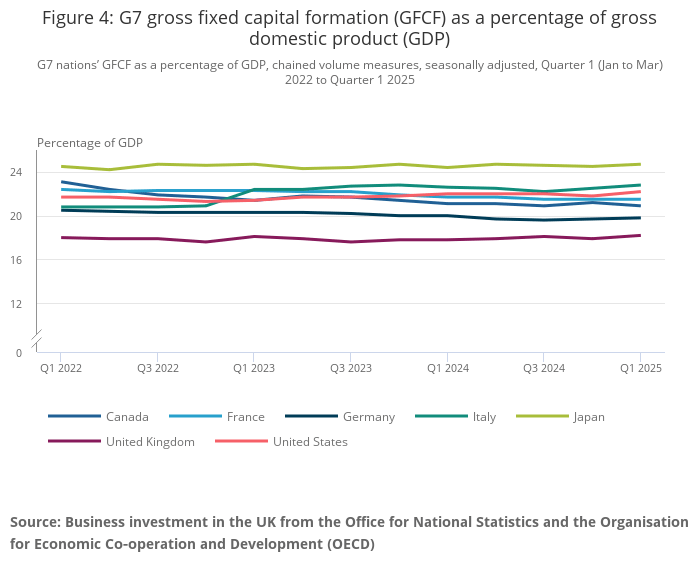
A tax system that penalises the returns to risk-taking, whether through higher CGT, inheritance levies, and corporation tax, or all three as in UK’s case, produces less risk-taking. This is Macroeconomics 101.
The government must decide what it actually wants from the private sector: a cash cow to fund public services, or a dynamic engine of growth and job creation. It cannot have both simultaneously.
The Budget next week will tell us which priority has won the internal argument. I fear I already know the victor, and it’s not the good guy.



Leave a Reply